
Which Arabic should you use? Modern Standard Arabic vs dialects
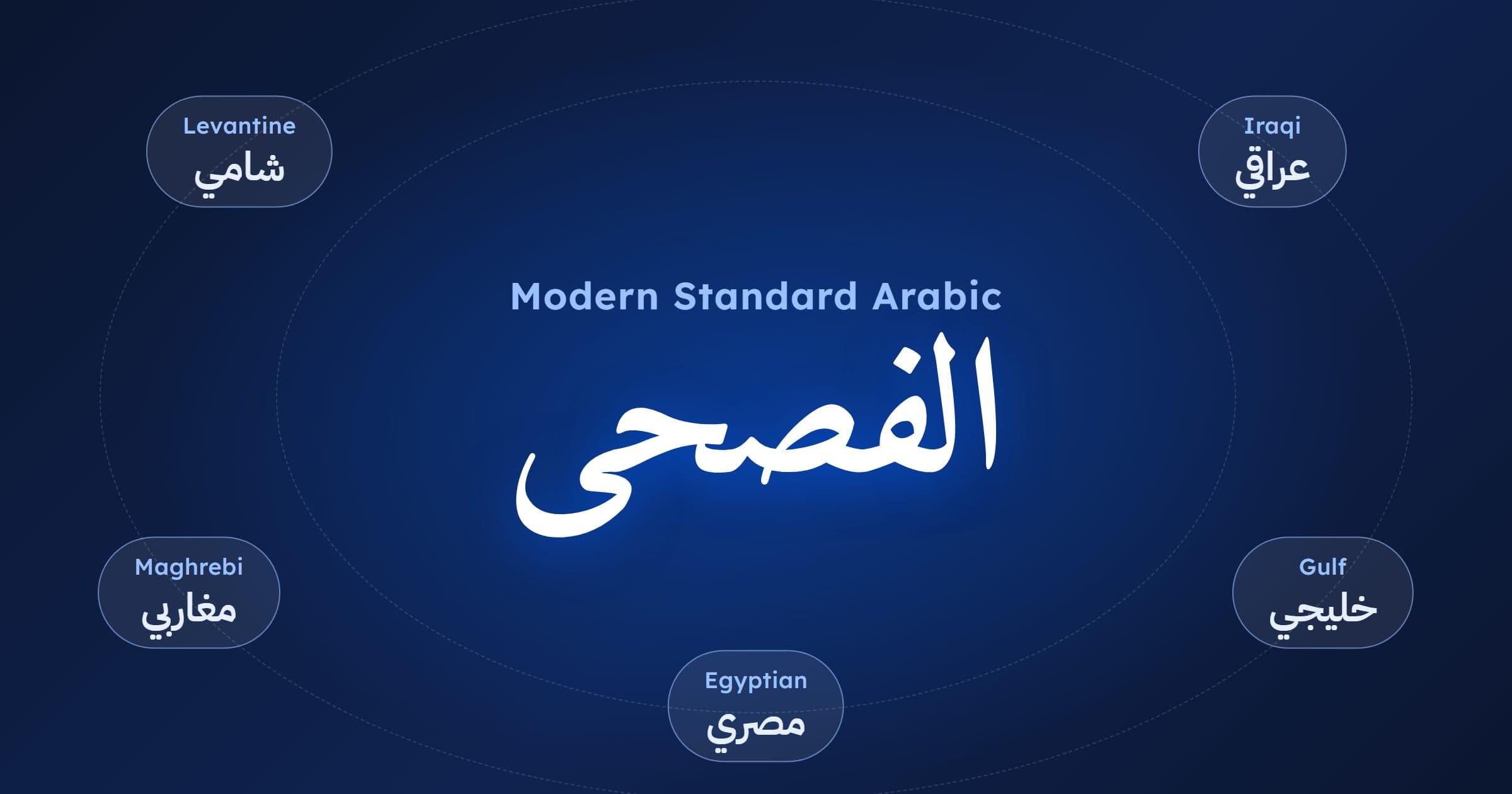
Arabic is spoken by more than 400 million people across more than 20 countries, but it is not one single variety. Before you translate anything, you need to decide which Arabic your audience should read. The right choice depends on what you are publishing and who will read it.
Modern Standard Arabic (MSA)
Modern Standard Arabic, called al-fuṣḥā in Arabic, is the shared written language of the Arab world. It is used in newspapers, books, official documents, contracts, education, news broadcasts and most websites. Every educated Arabic speaker understands it, from Morocco to Oman.
Use MSA for:
- Contracts, policies, legal and financial documents
- Technical documentation, manuals and help centers
- Software and app interfaces that serve several countries
- Corporate websites aimed at the whole Arab world
- Healthcare and education content
MSA does not have to sound stiff. A good translator writes clear, modern MSA with a tone that suits your brand, from formal to friendly.
The main dialect groups
People speak their local dialect in daily life. The main groups are:
- Gulf (Khaleeji): Saudi Arabia, the UAE, Kuwait, Qatar, Bahrain and Oman
- Egyptian: widely understood across the region thanks to Egyptian film and TV
- Levantine (Shami): Palestine, Jordan, Lebanon and Syria
- Iraqi: Iraq
- Maghrebi (Darija): Morocco, Algeria, Tunisia and Libya, the most different from MSA
Dialects are mainly spoken, so they are rarely used for formal writing. They work well when you want to sound close and personal to one specific market.
Which one should you choose?
| Content | Recommended Arabic |
|---|---|
| Contracts, policies, financial reports | Formal MSA |
| Manuals, help centers, documentation | Clear MSA |
| App or SaaS interface for several countries | MSA with a simple, friendly tone |
| Website for the whole Arab world | MSA |
| Marketing for one country | MSA with a local touch, or that country’s dialect |
| Social media and ads for one market | The local dialect often performs best |
| Video for a broad audience | MSA, or Egyptian for informal content |
| Customer support for one country | Simple MSA, with local words where natural |
A practical rule
If your audience is in more than one country, or the content is official, technical or long-lasting, use MSA. If your content is short, emotional and aimed at one country, such as a social media campaign in Saudi Arabia, consider the local dialect or MSA with a local flavor.
Many brands combine both: MSA for the website, product and documentation, and a light local tone for social media and campaigns. This keeps the brand consistent while still sounding natural in each market.
Common mistakes to avoid
- Mixing dialects in the same text, which confuses readers
- Using a dialect for formal content, which can look unprofessional
- Writing heavy, old-fashioned MSA for marketing, which feels distant
- Translating slogans word for word instead of adapting them through transcreation
Not sure which Arabic fits your audience?
Choosing the right variety is part of every project I take on. If you are unsure, tell me about your audience and goals and I’ll recommend the best option before any translation begins. You can also read about my consulting service, which covers this decision for larger launches.
Related service: Arabic translation