
Arabic localization glossary: 15 terms explained simply
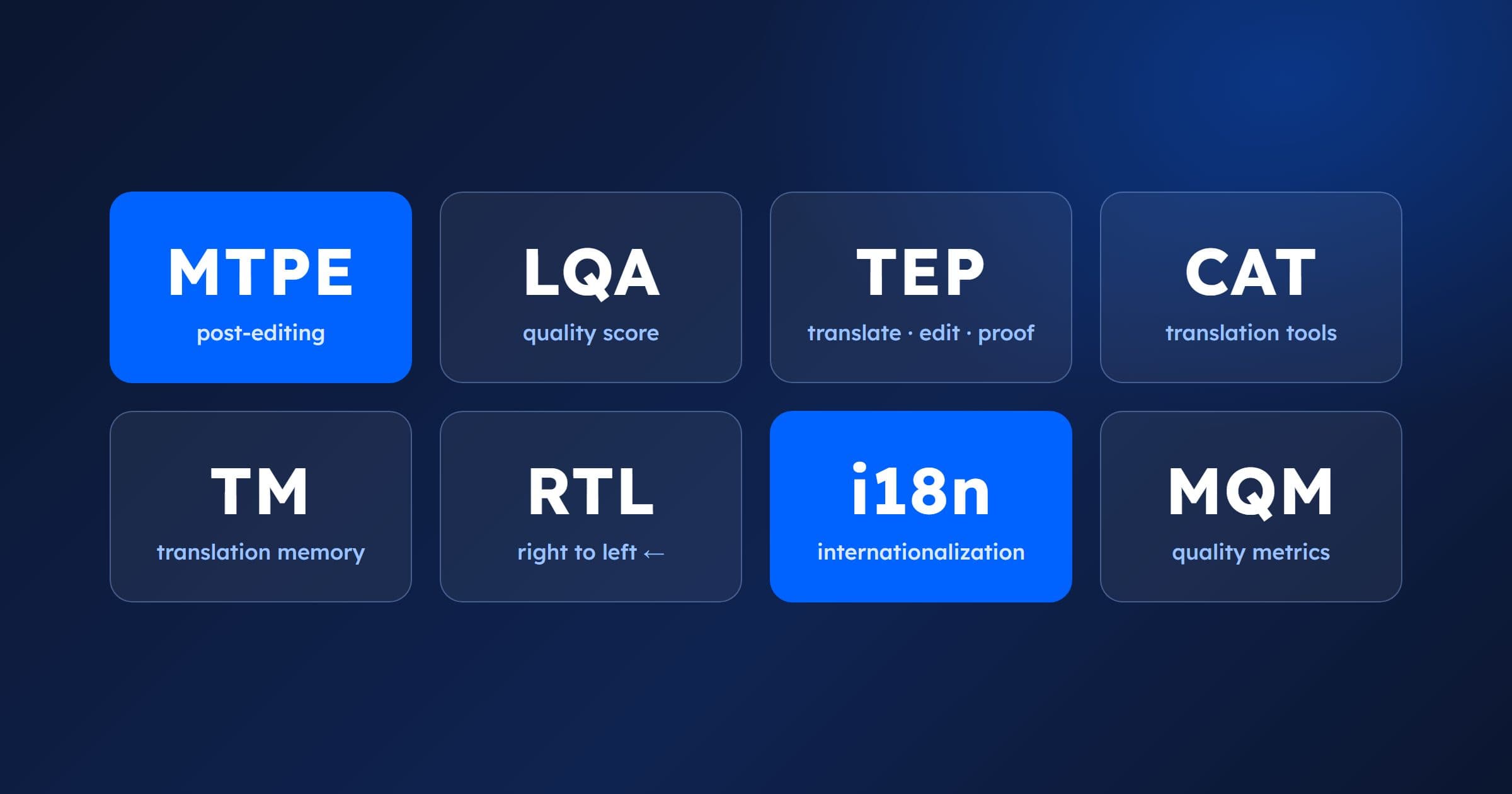
If you have ever received a quote or a vendor form from a translation agency, you have probably met a wall of abbreviations. This glossary explains the most common terms in plain language, with notes on what they mean for Arabic.
Localization
Adapting a product or content for a specific market, not just translating the words. For Arabic this includes right-to-left layout, dates, numbers, currencies, images and cultural references. See SaaS localization.
Internationalization (i18n)
Preparing software so it can be localized later: separating text from code, supporting right-to-left languages and leaving room for longer text. "i18n" stands for the 18 letters between the "i" and the "n".
Right-to-left (RTL)
Arabic is written from right to left. Websites and apps must mirror their layout, including menus, icons, arrows and progress bars, while numbers and Latin words still read left to right inside Arabic text.
Source and target
The source is the original text; the target is the translation. Translation is usually priced per source word.
CAT tool
Computer-assisted translation software, such as Trados, memoQ or Wordfast. It is not machine translation: it helps a human translator work consistently, using translation memories and glossaries, and it keeps the file’s formatting intact.
Translation memory (TM)
A database of sentences you have already had translated. When the same or a similar sentence appears again, it is reused, which keeps wording consistent and makes updates faster.
Fuzzy match
A sentence that is similar, but not identical, to one in the translation memory. Translators review and adjust it rather than translating from scratch.
Glossary or termbase
A list of approved translations for your key terms, such as product names, features and industry vocabulary. It keeps every translator, and every document, consistent.
Machine translation (MT)
Translation produced automatically by software. It is fast, but for Arabic it often makes mistakes in grammar, gender agreement, terminology and tone.
MTPE (machine translation post-editing)
A human linguist corrects machine translation output. Light post-editing makes it accurate and understandable; full post-editing makes it read as if written by a human. See MTPE.
TEP (translation, editing, proofreading)
The standard quality workflow: one step translates, a second compares the translation with the source (editing), and a final step checks the Arabic itself (proofreading).
Editing vs proofreading
Editing is bilingual: the translation is checked against the source. Proofreading is monolingual: the final Arabic is checked for grammar, spelling, punctuation and formatting. See editing and proofreading.
LQA (language quality assessment)
An objective way to measure translation quality. Errors are logged by category, such as accuracy, terminology or style, and by severity, then turned into a quality score and report.
MQM
Multidimensional Quality Metrics, a widely used framework that defines the error categories and severity levels used in LQA.
Transcreation
Recreating a message, such as a slogan or campaign, so it has the same effect in another culture, rather than translating it word for word. It often comes with a back-translation into English so you can see what the Arabic says. See transcreation.
Have a term that isn’t here?
If a quote or a vendor form uses a term you don’t recognize, just ask me. I’m happy to explain how it applies to your project.
Related service: Arabic translation